


The world is digital, but life is analog..
In the latest session of the Global Classroom Initiative for DRE2213 Programming and Data Structure and BTE1522 Innovation (Python Programming) students were privileged to attend a talk by Prof. Ansgar Meroth from Helbron University. Prof. Ansgar delivered a comprehensive overview of IoT networks, particularly as applied to agriculture. This talk aligned perfectly with our BTE1522 … Continue reading “BTE1522 DRE2213 – Week 5 Global Classroom”

In the latest session of the Global Classroom Initiative for DRE2213 Programming and Data Structure and BTE1522 Innovation (Python Programming) students were privileged to attend a talk by Prof. Ansgar Meroth from Helbron University. Prof. Ansgar delivered a comprehensive overview of IoT networks, particularly as applied to agriculture. This talk aligned perfectly with our BTE1522 and DRE2213 course’s focus, as students in the DRE course gain hands-on experience in Python programming, Raspberry Pi programming, and embedded systems.


Prof. Ansgar’s lecture began with the foundational elements of IoT, including sensors, network architecture, and the various considerations in building robust IoT solutions. Moving deeper, he shared insights on the types of sensors used, architecture design choices, and a project demonstration from his own classes. The talk’s focus on agricultural IoT applications illustrated the immense potential of these technologies to transform farming through precision monitoring and automation.


Key Points Covered in the Session


Q&A Session with Prof. Ansgar
The session concluded with an engaging Q&A, where Prof. A addressed various thoughtful questions from students, demonstrating his deep expertise and providing practical guidance. Here are some of the key questions asked and the responses-
1. What are the critical components in developing a reliable and quality IoT solution?
There is a critical need for high-quality sensors, a robust network architecture, and efficient data handling techniques. Reliability can often hinge on the durability of sensors in harsh environments, as well as on efficient protocols for data transmission.
2. What are the considerations for choosing the right sensor in IoT solutions if cost isn’t an issue?
Prioritizing sensor accuracy, durability, and compatibility with other IoT components are recommended. Environmental factors, such as weather and soil conditions, also play a role in sensor selection for agricultural applications.
3. How can we optimize performance in IoT systems with limited power on Raspberry Pi?
Sleep modes and power-efficient protocols, such as MQTT, which is designed for minimal data transfer could be considered. Edge processing can also reduce energy usage by minimizing the amount of data sent to the cloud.
4. How do you ensure reliable data transmission and handling in IoT systems that operate on edge devices?
Using reliable networking protocols and setting up redundant systems to handle transmission errors is a good option, especially in remote areas where network stability may be an issue.
Additional Questions from the Class
1. What is the difference between IoT and IIoT?
While IoT focuses on general applications (e.g., smart homes, agriculture), Industrial IoT (IIoT) emphasizes industrial and manufacturing applications, where the systems must adhere to stringent standards for reliability and security.
2. In hazardous environments, what role does IoT play in monitoring and managing assets safely, and how reliable are these systems?
IoT can monitor environmental conditions and equipment status in real-time, alerting managers to unsafe conditions instantly. With proper system design, these systems can achieve high reliability.
3. What are the potential environmental benefits of using IoT for precision farming?
IoT enables precision resource management, reducing waste and minimizing environmental impact by providing data-driven insights into irrigation, fertilizer use, and crop health.
4. How can data security and privacy be ensured in an IIoT network?
Security is critical in IIoT, where implementing encryption, secure authentication protocols, and regular system audits could be implemented to mitigate risks.
5. How can organizations ensure a successful IIoT implementation without facing cybersecurity risks?
A layered security approach, including firewalls, intrusion detection systems, and ongoing employee training to protect against cybersecurity threats.
6. Are there devices beyond sensors or GPS that can accomplish tasks within IoT or IIoT?
Actuators and drones as examples of devices that can not only sense but also act on data, allowing IoT systems to respond autonomously to changing conditions.
7. What about the durability of sensors used in IoT farming systems? Are they different in quality or sensitivity compared to similar sensors in everyday devices?
In agricultural IoT, sensors are often designed to be more rugged, with higher sensitivity and protective casings to withstand outdoor environments. These are tailored for extended use in tough conditions, unlike everyday consumer electronics.


It was both an honor and an incredible experience to host Prof. Ansgar from Helbron University. His insights into the intersection of IoT, embedded systems, and agriculture were inspiring, providing our students with a glimpse into the future of technology-driven farming. Listening to fellow educators motivates me to creating opportunities for global collaboration and learning. As someone who believes deeply in breaking down barriers in education, I look forward to inviting more professors from around the world.
Engaging with international experts not only enriches our knowledge but also motivates us to strive for higher standards in our projects and activities.
Kudos to the students who actively engaged with Prof. Ansgar and asked thoughtful questions during the session. Their curiosity and commitment to learning demonstrated the high standards they are reaching for, making this session even more impactful.
Thank you, Prof. Ansgar, for sharing your expertise and inspiring us to innovate!
This week, students from the BTE 1522 and DRE 2213 courses are given assignment that are designed to develop their programming skills in Python. Each group of three students is tasked with choosing one of the 20 game modification options available and implementing it as a team project. This assignment is all about creativity, problem-solving, … Continue reading “BTE1522 DRE2213 – Week 5 Assignments”


This week, students from the BTE 1522 and DRE 2213 courses are given assignment that are designed to develop their programming skills in Python. Each group of three students is tasked with choosing one of the 20 game modification options available and implementing it as a team project. This assignment is all about creativity, problem-solving, and teamwork as students work to modify an existing Python game and showcase their programming concepts.
In this assignment, each group will:
Each group will submit:

To complete this assignment, please:
Upload these in KALAM (https://kalam.ump.edu.my/)
As part of the final submission, you are encouraged to be creative with their 3-minute video, which should highlight –
Good luck to all the groups, and I look forward to seeing your creativity come to life in your games!


Hybrid classes this week. BTE1522 DRE2213
Hybrid classes this week.
BTE1522


DRE2213


♦
♦


STEM Summit 2024 is happening now Website Exploring Pedagogical Approaches in Arduino Robotics Through Hands-On Experience at the 2024 IEEE STEM Summit The 2024 IEEE STEM Summit brought together educators, researchers, and industry professionals to explore the latest trends and challenges in STEM education. At this event, I had the honour of presenting on … Continue reading “2024 IEEE STEM Summit”
STEM Summit 2024 is happening now Website


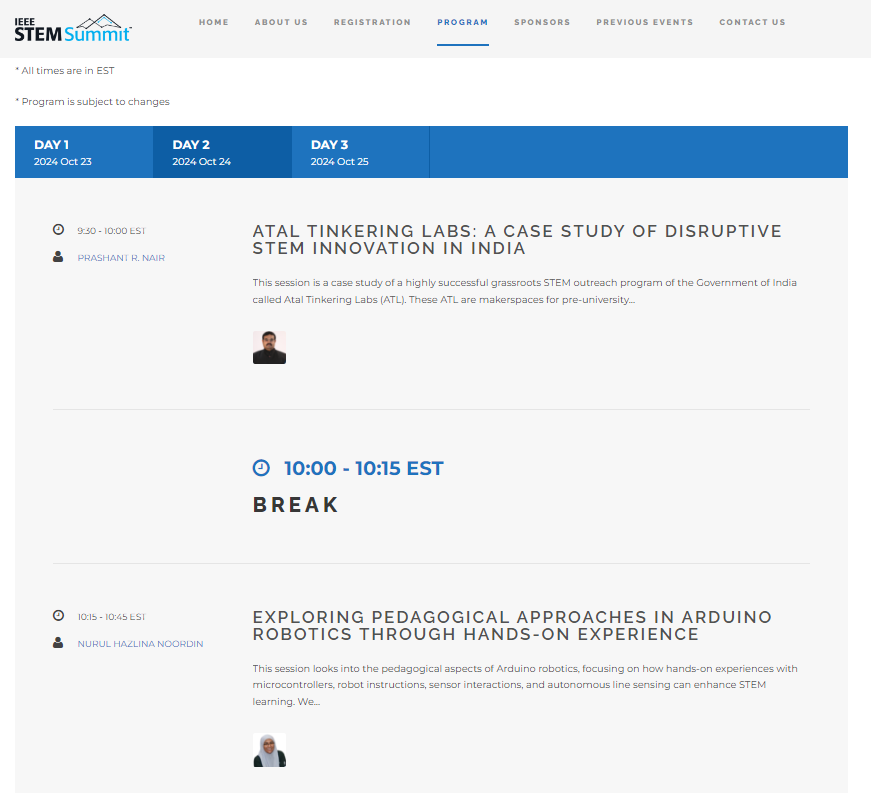


Exploring Pedagogical Approaches in Arduino Robotics Through Hands-On Experience at the 2024 IEEE STEM Summit
The 2024 IEEE STEM Summit brought together educators, researchers, and industry professionals to explore the latest trends and challenges in STEM education. At this event, I had the honour of presenting on “Exploring Pedagogical Approaches in Arduino Robotics Through Hands-On Experience,” where we discussed methods of engaging students in robotics, focusing on building skills through direct, hands-on activities.

The presentation aimed to illustrate the value of blending practical robotics work with foundational theory, especially when working with Arduino robotics, to enhance student learning outcomes.
Key Themes and Teaching Approaches
The main theme of this presentation was how a well-designed hands-on approach can havean impact on learning and make complex topics like robotics and electronics more accessible. Teaching Arduino robotics requires balancing both theory and practice. For students to truly understand the inner workings of a robotic system, theoretical concepts should be taught alongside practical applications, where students directly apply what they’ve learned.

In developing a well-rounded robotics curriculum, the following approaches are emphasized:-


Towards the end of the presentation, participants posed questions, reflecting on the pedagogical aspects in enhancing the Arduino robotics curriculum.
Here’s a recap of some key questions and my responses –
The presentation highlighted how hands-on learning in Arduino robotics can be transformative for students, whether they are beginners or more advanced learners. Through a scaffolded approach that combines theory and practice, students develop not only technical skills but also critical thinking and problem-solving abilities. The summit was an excellent platform to share these insights and learn from other educators in the field who are equally passionate about making STEM accessible and engaging.
Again, thank you IEEE TryEngineering for the opportunity to present at the 2024 STEM Summit! It was an honor to share insights on hands-on learning in Arduino robotics and to explore the impact of the right pedagogical approach in helping students connect with engineering concepts meaningfully =). I look forward to continued collaboration and applying these techniques to create even more engaging learning experiences. Kudos to all the speakers for their inspiring talks and fantastic!


